Archival practical content: the article preserves a historical overview of the organization of a small workshop and workbenches, but is not a workplace project, load assessment or safety instruction. The work surface, supports, clamps and fasteners must correspond to the weight of the tool, the forces during operation and the manufacturer’s instructions. Electrical, plumbing, gas and structural work should be left to qualified persons when there is a risk of electric shock, fire, leakage, flooding or loss of stability.
Today, Savo Kusić is focused on wooden windows, wooden-aluminum windows, custom windows, doors and requests for quotation. This article remains a historical archive and does not represent an offer of workbenches, tools or home repairs.
How to organize tools
Practical and good storage of equipment and tools is of great importance. So we quickly find the part we are looking for, put it back in its place after use and more easily spot the part that is missing because it was forgotten, borrowed or lost.
To prevent rusting, you should avoid keeping tools outdoors, even in cabinets, as well as in damp rooms. A practical solution is a cabinet of suitable dimensions for tools and small materials such as nails, screws, glue and gaskets. Suitable pegs, hooks, slats with holes and other fasteners can be attached to the inside of the cabinet.
When the tools are sorted, the outlines of individual tools can be drawn with a pencil. That makes it clearer where each item belongs and whether anything is missing. Awls, taps, dies and drill bits can be kept in labelled, sturdy metal or wooden boxes. If the equipment was supplied in a suitable box, it is enough to label the box and place it in the cabinet.
If there is a permanent place to work, the tool can be hung on a wall perforated plate with hooks, clamps, pegs and other holders. One or two cabinets can also be useful for smaller materials.

Cabinet for holding tools and smaller materials — historical illustration.
Safe storage: wall plate, cabinet, shelves and brackets must be fixed according to the base and the actual load. Sharp and heavy objects should not be placed so that they can fall, and chemicals, adhesives and flammable materials should be stored in their original packaging according to the manufacturer’s instructions, away from heat sources and out of the reach of children.
Workbench and auxiliary work surface
Many jobs are done on site, but repairing appliances or drawers, making furniture parts, mechanical repairs, and small sheet metal or blacksmith work requires a flat work surface, and often a real work table.
For those who do not have a lot of space and do not work often, a simple solution can be a solid wooden board with a support system and attachment to the existing table. The worktop can be of larger dimensions — a meter and a half by a meter or more — and after use it can be hidden behind the closet or leaned against the wall in the pantry.
Rubber or fabric is placed between the board and the table so that the table is not damaged. A vise or a small machine can be attached to such a work surface.
A portable board is not automatically a workbench: the existing table, board, underlay and every attachment must be checked for weight, tipping, vibration and tool forces. A vise or machine must not be placed on a household table without confirmed load capacity and stability. The workpiece must be secured, guards must remain fitted, and cables and the work area must not create a trip hazard.
If there is space in the house or utility room and work is done more often, a dedicated workbench can be chosen according to the space and type of work. It can be a carpentry bench with clamps for boards, plates and other material or a table for mechanical and locksmith work.
A woodworking bench top is traditionally made from tightly joined timber sections several centimetres thick so that it can withstand impacts, a vise and various machines. However, the choice of materials and construction must be based on the actual load, joints, supports and the equipment manufacturer’s instructions.
One solution between a fixed bench and an auxiliary board is a folding workbench. It can be stored in a utility room or behind other furniture while providing a dedicated work surface when properly unfolded, locked and loaded within permitted limits.
Woodworking and metalworking benches
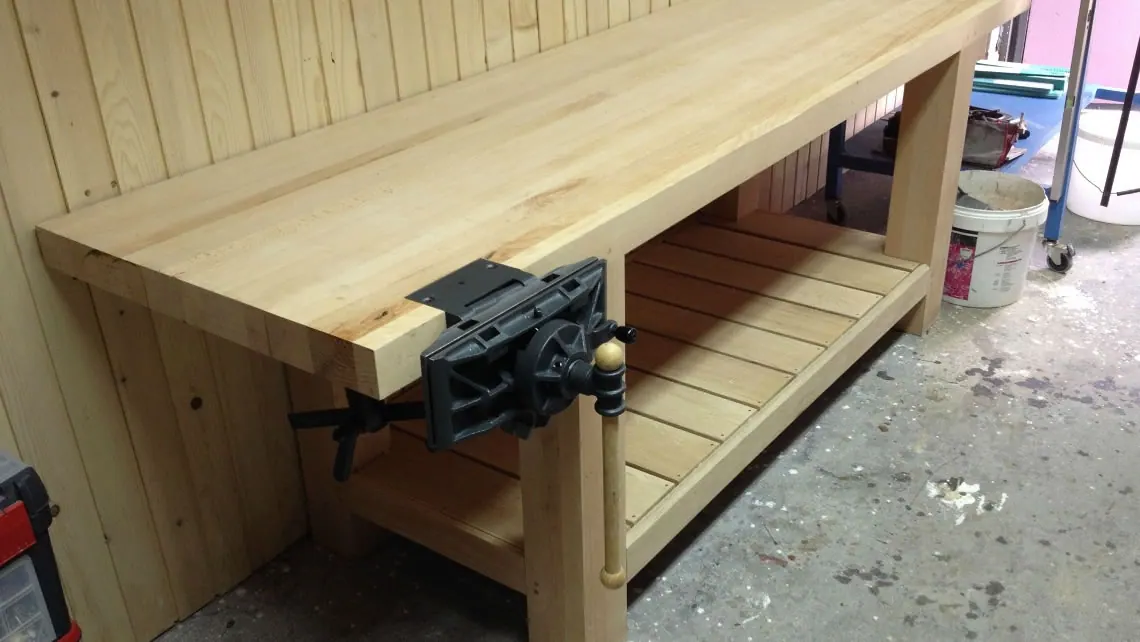
Woodworking and metalworking benches are classic professional craft workbenches of a defined size and mass, with equipment such as sliding vises and holes for securing the workpiece.
Modern workbenches can have a metal or wooden top and places provided for saws, routers, stand-alone machines or accessories for electric drills. Some models have guides or a variable angle plate for sawing and drilling at a specific angle. There are also collapsible, portable models of smaller dimensions intended for occasional work.

Woodworking bench with a front vise and sliding parallel vise — historical illustration.
Bench-mounted machines: a precision guide or variable angle does not eliminate the need for guards, push sticks, dust extraction, eye and hearing protection and proper clamping. The machine and bench may be used only in a combination permitted by the manufacturer. Before adjustment, tool changes or removal of jammed material, the power supply must be switched off and secured against accidental starting.